Showing posts with label Shelter in Place. Show all posts

Tuesday, April 13, 2010

Preparedness Drills - DIY


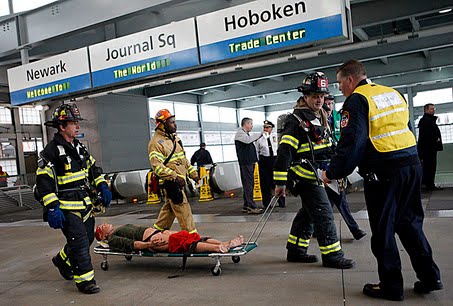
AP Wirephoto
In order for you to become proficient in handling emergencies and getting a feel for how your plan works you should drill just like safety professionals do. What better way for you to experience how it feels to be without power, lights, running water and whatever realistic situations you might encounter?
Another form of this drill would be for you to ask the family to prepare (on short notice - much like an unannounced fire drill at work/school) to evacuate your residence because of an overturned tanker or gas leak or flooding. Have you seen the media footage of people with advance notice of impending calamity needlessly carrying out their plasma tv's? "Unprepared" would be a very kind word to use.
Many people seemingly don't have to drill because they have this experience first hand - floods, tornadoes, hurricanes, fires etc.. Many of these folks are already well versed and often ready to respond. Most people still are not.
So, for those who aren't and want to actually see themselves and families in action - now is as good a time as any. Some family members may be reluctant to be involved but considering the consequences of not being prepared are great - it will be a time to test interpersonal skills as well.
Potential scenarios:
Shelter in place for one full day - yes- say 24 hours. No phones, no electricity, no running water - no TV. What back up plans are in place to deal with this and what equipment is set aside for this - use it like you would during the real deal.
Mock Evacuation to another location or relatives house packing your gear out in your vehicle or whatever conveyance you decided to use. City residents may have to try alternate means to get to their destination...make the drill as realistic as possible. Test your emergency shelter or vehicle equipment realistically. If you live in an industrial area you may need to recognize hazards and plan for emergencies that might occur. Don't wait for others to dream up these scenarios for you. They will be a long time coming!
Reroute Drill. Devise an alternate route home from school, work or a place you frequent due to an emergency like a plane crash, fire or traffic accident (fairly common) but close off your normal route and see what difficulties or challenges you encounter. You might even consider offering this as a game for the kids....within reason depending on age. Practice a first aid scenario and you can put a participant 's arm in a sling to replicate an injured limb.
Remember these situations are quite possible and it is better to know now what it might be like and how to compensate because it may save your life.
Post Drill:
When you finish your prescribed exercise, debrief everyone and make necessary changes to your plans. The experience and insight you gain from these exercises is the key as your actual plan may not adequately deal with the emergency exactly as you planned.
Your decision making skills and increased knowledge from interacting with your team will now allow you to make those important choices more decisively. Don't be dissuaded from conducting a drill because of what someone naysayer says - they will always be the first one's over to get YOUR help in an emergency.
Mindset:
Do this with trusted family or some friends and try it being low key at first. You don't want the whole neighborhood knowing you are the prepared one and having them show up at your door - or shelter, because they are feeling too entitled or downright lazy to take care of themselves.
We live in an entitlement (aka nanny state) society now and many expect that costly helicopter rescue to save their day - reality is something else altogether!
Seeing that government has not adequately involved citizens in any realistic drills or school training - you need to do it yourself. More to follow.

Thursday, February 18, 2010

Amazing Survival Story or Need for Preparedness?


http://tinyurl.com/yhx6ufw

It is always difficult to criticize as an armchair quarterback but the only way others learn sometimes is by example.

This story on Fox News 2-18-10 about a fellow named Jason Pede on a business trip stranded 73 hours on a snowpacked Colorado road because of a wrong turn or bad directions is a good example. We are relieved he made it out alive....let us use his example to help others.

Some background:
Pede was operating a Lincoln Navigator - A large SUV with plenty of room. He was a professional driver by trade. He was admittedly out of shape and only had high sugar content soda and sugar wafers in his car for food. He was given directions on the road that may have been wrong and his GPS may have provided incorrect directions as well.

Pede was 7 miles away from any assistance when he became stranded and no one knew where he was. His wife lost contact with him as his cell phone battery may have died out or was out of range or both. He got his truck stuck in hood high snow when he tried to turn around.
His decision to not walk out (ok decision actually) was because Mr. Pede was out of shape (not a good decision). He managed to make fire "during the day"which melted his truck panels.

He "survived" by drinking Mountain Dew and eating Sugar Wafers until he ran out of gas for his truck. He then decided to walk out to seek help. Was he lucky?

As we have repeated here for 5 years....knowledge in an emergency is critical. More so than high tech gear.

He admitted now if he knew to only run his vehicle 10 minutes per hour to stay warm he would have conserved fuel and could have stayed in the truck.

Critique:
Ok. What might YOU have done differently?
Some of these items below may have been in play already. We have detailed these in a training memo last year which is on the website.....

Some suggestions:
Notified someone (wife in this case) of your new route via cell phone.
Mark Route on paper so contact knows it - and so rescuers can start an effective search
Carried at least one emergency evacuation/survival kit on board.
Flares/Lithium Powered LED FlashLights or Headlamps
Spare Batteries/Chargers
Aerial Flares/Rescue Strobe Light (Marine or Military- not toy versions)
Survival Food for 3 days - minimum
Water 2 1/2 gals - not sugar loaded soft drinks
First Aid Kit
Alternate Heat/Cooking Gear - Alcohol Based OK
Survival Candles - Long Duration High Density - Can be used for Cooking /Heat
Backpack
Sleeping Bag or Mylar Reflective Blankets - 1 per occupant
Parachute Cord
Survival Knife
Spare Warm Clothing Appropriate for Inclement Weather - Hats/Gloves
Portable Shelter (aka Tent/Tarp)
Snowshoes/Boots
Shovel
Tire Chains as required by State Law in many instances
Road Map
Firearm for Protection if licensed
Been in Better Physical Condition
Don't rely on your phone as your only survival tool.
Left an emergency survival manual in this large vehicle.
This would have been an actual bonified good opportunity for using OnStar (GM still knocks those of us who can't afford it and are personally prepared using ICE)

We will add more as we go forward...... He could have stayed put with this gear.

3-8-10
Jason has commented below....and makes a great point! If you have two cars (or more) all cars should be equipped with some basic essentials for survival.

Wednesday, November 11, 2009

Emergency Water Saving Device - WaterBob


No, it is not a toy, but yet another niche product that might prove effective in a shelter in place incident that has some duration. This device is made of plastic and molds to the contours of most common tubs found in homes or apartments to contain an instant supply of water. It won't replace water containers used when you evacuate - but it will secure a considerable amount of water in short order.
WaterBob claims to this device being rated to hold 100 gallons of water obtained from your tub faucet and can be filled in roughly 20 minutes. It comes with a simple pump device to extract the water as needed.
While it is claimed that the water could prove potable for up to 4-5 days this can be extended of course by using water treatment chemicals or devices to filter water as it is removed from the bladder.
You could store this on site and use this at the first indication of a shelter in place scenario or impending storm - or take it with you to you planned back up retreat if it is another home or apartment and used there. While filling it up you can attend to other tasks at hand like boarding up windows or securing items for an evacuation if need be.
Of course when full you would not be able to take it with you but considering the amount of water secured "inside" the bladder and not laying out exposed in a bathroom environment this can make a hopeless situation livable for a while.
CampingSuvival.Com carries them for about the price of a 5 gallon military water container which we have discussed in earlier blogs. If you have two tubs - great for you! If not, consider how you will be attending to a modified routine of personal hygiene.
This is one more good reason to keep your bathroom clean. Also don't forget that your toilet tank holds a reserve of water as well - not much, but it is there....and treatable.
Nothing is absolute in this preparedness effort as circumstances change and needs arise that may be totally out of your control but having redundant measures in place considerably increases the odds of your overcoming the odds against you in an emergency. This would be a good adjunct to your emergency water preservation efforts.
Mention Coupon Code "ICE" and get 5% off......more to follow.
Special Promotion: Be the first three people to email ICE4SAFETY with your name address and email address and you will receive one free WaterBob from CampingSurival.Com!

Thursday, February 5, 2009

Boy Scouts Embrace Preparedness Concepts


It was no surprise when Tom Sciacca from CampingSurvival.Com and ICE4SAFETY co-hosted a group discussion with BSA Troop 888 in Oswego, New York last night. We were welcomed by an enthusiastic (large) and well informed group of Scouts and parents who found the discussions on wilderness and urban preparedness/survival to their liking.


What a tremendously polite and attentive audience we had!


Oswego lies in the Lake Effect Snow Belt of New York State and they get pounded yearly with records amount of snow...so they have an understanding for the need to be prepared. Scoutmaster Steve had made sure everyone was on top of their game for the evening when the scouts and the adults were engaged in the discussion.....we were having such a good time, Steve had to remind us when to leave!


Scouts got to sample some of Tom's survival ration bars while washing it down with some white pine needle tea which was brewed on the spot. A tip from the audience - white pine needles come arranged in groups of five - white has five letters....so easy to remember.


Our friend up above demonstrated for everyone how warm (and how much fun) he could have by just draping himself with one of the ICE4SAFETY survival kit rescue blankets - just one of the various practical survival tools demonstrated that night.


Realistic survival techniques and consideration discussions ranged back and forth from wilderness to urban situational awareness to evacuation or sheltering in place concepts during an emergency. The group was actively engaged and challenged to participate in the discussion about "dressing for success" and the concept of the "Gray Man" principle. There were some humorous moments for sure.


Survival rule of three (3) was driven home more than a few times as well....3 hours without shelter, 3 days without water and 3 weeks without food. We supplied the scouts with hand outs about Vehicle Emergency Equipment, Emergency Medical Info Forms, ICE Cards and Stickers, Brochures and of course MRE's (for home) and those survival ration bars ......they grow on you.


You probably won't see these scouts going to the winter ski hills dressed in summer flip flops and pajamas anytime soon like their young school friends - they know better. It looks like these folks will also be checking out a favorite survival school in the near future to further advance their learning experience.


One last point that was stressed - when it comes to being personally prepared....if YOU are prepared, then you will be able to actually help others (neighbors, friends, family) who may desperately need your help.


The Scout Motto to "Be Prepared" is as relevant today as it was when it was first adopted by the Scouts. Actually it has been in vogue since 2001.

CampingSurvival.com will feature more pics of the event shortly as well.


Thank you Scoutmaster Steve and Troop 888!


Girl Scouts next? Already been asked.....

Monday, October 8, 2007

Prep Tip - Water 2 - Shelter in Place


Water - Here is a low profile and obvious way to store upwards of 60 gallons of clean water without really trying. Most homes and apartments have water heaters that are easy to get to.
You have to flush the tank regularly to remove solids and sediment - mark the tank prominently with a big high visibility label stating "purge monthly". This will involve opening the drain valve and overpressure valve to flush out the minerals and sediment precipitated out from heating the water.
If the overpressure valve doesn't work - replace it - water heaters can explode. You need to drain the unit yearly if you have the ability and means to do so (a hose and drain lower than the tank drain valve will work).
If you are getting a new tank - replace the cheap plastic drain valve with a brass boiler valve that won't leak the first time you use it - and then flush it regularly once a month. If you have a whole house sediment or chemical filter even better...you can adjust your flushing schedule accordingly.
When the situation calls for it, turn off the supply valve to the tank turn off the gas valve or electric supply and drain water as needed. You may want to have a butane gas stick lighter on hand to reach the gas pilot if you start it back up.
One half inch of sediment can result in 70% more energy use so do yourself a double favor - save money on heating and keep your back up water clean and handy.
Got a tankless system - see water prep tip 1.

Tuesday, September 25, 2007

Mindset - Emergency Management - Tip 1

Being prepared for emergencies in the Corporate World is called Emergency Management and Business Continuity Planning - it is big business in itself right now.....so how about having the same attention for you and your family? Sure thing.

Here are some bullet points to keep in mind while you formulate your plan(s) for being prepared... as you get your "gear" in place and integrate more situational awareness into your busy lifestyle you will develop more options - and options are what you want. As mentioned before, being on a roof waving for help is not your best option.
Let's refresh some things you likely already know but need to think about again as you plan....
  • During and emergency, whether it be natural or man made, you and your family may suffer injuries that could be life threatening or at least hamper your ability to help yourself.
  • You may temporarily suffer from emotional or psychological shock that can and will disorient or confuse you to the point you may not be able to think or act appropriately.
  • Complex tasks may become nearly impossible to accomplish for some period of time.
  • The weather may be extremely hot or cold, rainy or windy or dry.
  • Power, water, communication, security, mobility, shelter may all be unavailable.
  • You may be (far) away from your home and emergency supplies or cut off by a natural disaster or massive influx or exit of other people relocating.
  • You need to decide whether to "shelter in place" or "bug out" (common parlance nowadays) and you should have criteria in place for making that decision when/if the time comes.
  • Your plans to meet other members of your family may become impractical due to a variety of reasons...but pre-planning helps you to better understand what needs to be done in situations and what others can and will do if the designated plan can not be enacted. They call this innovation or Plan "B" or "C"....
  • Crowds and lawlessness in large disasters happen, being alone without help may require some drastic measures.
  • Help from the government agencies as portrayed on TV are not realistic and you need to realize this right now - your friends and family as well.
  • People in some parts of the country that don't suffer many disasters may think you are crazy for taking the time for being prepared (these are also the first to show up at your door for help as well). This may include members of your own family so be prepared for that.
  • You can accomplish some level of preparedness no matter where you live and where you are and you can improve the odds or your coming out okay as well. You need to put yourself in the proper mindset.....more to follow.